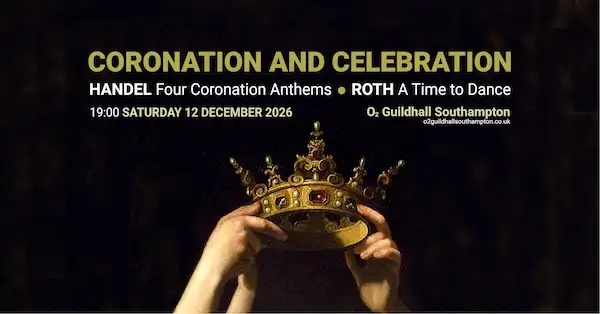
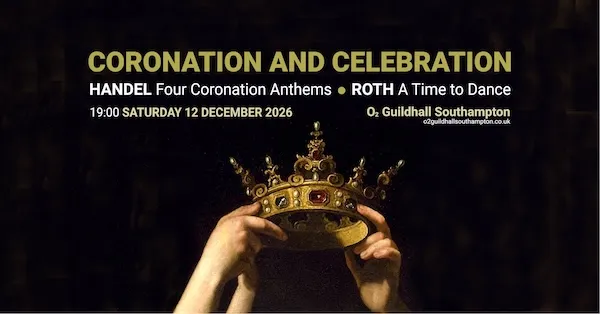
Coronation and Celebration — Handel Coronation Anthems; Roth A Time to Dance
Southampton Philharmonic Choir and Southampton University Philharmonic Choir with Oxford Bach Soloists.
Few pieces can match the anticipation of Handel’s Zadok the Priest, or the exhilaration when the massed voices finally ring out.
Written for the coronation of George II and Queen Caroline in 1727, Handel’s Four Coronation Anthems transform royal ceremony into music of extraordinary theatrical power. Each anthem was associated with a different part of the coronation service: The King Shall Rejoice with the Recognition, Zadok the Priest with the anointing, Let Thy Hand Be Strengthened with the enthronement, and My Heart Is Inditing with the coronation of the Queen.
Zadok the Priest draws on the biblical account of the anointing of Solomon. Handel’s setting has subsequently been performed at every British coronation, making its opening — the quiet building orchestral introduction, building to the sudden proclamation of the chorus — one of the most familiar moments in British ceremonial music.
Alec Roth’s A Time to Dance approaches celebration from a very different direction.
The work begins with the familiar words of the biblical book of Ecclesiastes: “To every thing there is a season”, and explores the passage of time through four sections: Spring Morning, Summer Noon, Autumn Evening and Winter Night. Roth describes four themes running throughout the work — times, seasons, love, and dance.
Roth says that he considered more than one hundred poems from a wide range of writers before selecting twenty-nine for the final work, with poets ranging from Ovid and Aphra Behn to William Blake, Emily Dickinson and John Donne.
Both works have celebration at their heart, but they celebrate very different things: Handel gives us ceremony, proclamation and public spectacle, while Roth turns towards the cycles of the day and year, the stages of life, love, mortality and the simple human impulse to dance. Together, they explore how music helps us mark the moments that matter.
A meeting of Baroque and contemporary
Although Roth’s music is contemporary, A Time to Dance has a particularly close relationship with the Baroque repertoire in this programme.
Roth explains that the work was originally conceived to be performed alongside Bach’s Magnificat, and he deliberately used essentially the same orchestral forces: soloists, choir, strings, oboes, bassoon, trumpets, timpani and continuo organ. The work can be performed with either modern or period instruments.
That makes the pairing with Handel especially natural: the sound-world of the Baroque orchestra provides a thread that connects music composed almost three centuries apart.
- Oxford Bach Soloists orchestra
- Holly Smith soprano
- Alicia Hunt alto
- Hamish Garland tenor
- Iris Oliver bass
- Cole Bendall conductor